


Hogties & Connectors




What to look for in hogties & connectors
X-frame connectors — adjustable vs fixed
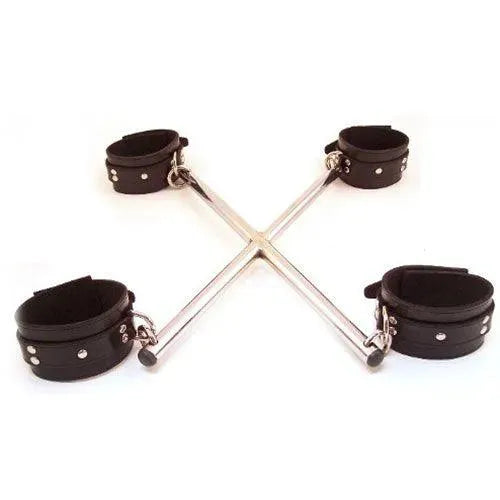
The standard hogtie connector is an X-shaped frame with 4 arms, each ending in a clip or O-ring that attaches to a wrist or ankle cuff. From there, the two types work quite differently.
Adjustable connectors use press stud positions or sliding arms to change the distance between wrists and ankles. A looser setting leaves some movement; the tightest setting pulls the limbs close together and removes almost all of it. That makes them the more practical choice for regular use with different people or positions.
Fixed steel connectors hold the limbs at one set distance with no adjustment possible. Once the padlock closes, the position is locked in. The restriction is more complete, but it also means knowing exact wrist and ankle measurements before buying — a fixed-ring steel binder cannot be altered after purchase. Check sizing carefully.
Connector hardware — chains, snap hooks & extensions
Chains, double-ended snap hooks, and carabiner links join existing pieces together, extend reach between anchor points, or connect a collar to a wrist cuff. They don't create a restraint position on their own.
A steel chain with carabiners at each end can connect a floor anchor to a wrist restraint, or extend the distance between cuffs that sit too close together. Double snap hooks clip between two D-rings at once, removing the need for a separate carabiner at each end. Their value is entirely in what they make possible within a larger setup. If you're building from scratch, a bondage kit that includes cuffs and compatible hardware is a cleaner starting point.
Armbinders
Armbinders pin both arms behind the back using a harness worn across the upper body. A horizontal strap holds the upper arms in place; a wide forearm binder wraps both forearms together and fastens with multiple buckles. Both arms are locked behind the back, with the front of the body fully exposed and accessible.
Most armbinders adjust across a range of arm sizes. Better-made versions have lock-compatible buckle hasps for added security. They're a more involved piece of kit than an X-frame connector, suited to setups where arm restraint alone is the focus. For multi-point linked restraint covering the neck, wrists, and ankles in one system, collar and body-link restraints cover that.
Safety in the hogtied position
The hogtied position has specific risks that go beyond standard restraint safety. Face-down with wrists and ankles drawn behind the back, the wearer has almost no ability to adjust position or signal distress. Self-release is not possible.
The person applying the restraint must stay present and attentive at all times, with a means of quick release immediately to hand. For padlock closures, the key must be within arm's reach — not across the room. Check circulation regularly and watch breathing carefully in this position. For anything more intense than a straightforward X-frame connector, spreader bars are a less demanding alternative that keeps limbs separated and easier to monitor.
The appeal of hogties & connectors
The hogtied position puts the wearer face-down, limbs behind the back, with almost no freedom of movement. For whoever applies the restraint, that level of positional control is what makes it different from cuffs alone.
Adjustable X-frame connectors suit setups that need to shift — changing the tension mid-scene, or fitting different people without swapping hardware. Fixed steel binders suit scenes where the absolute absence of movement is the point — where no amount of effort from the wearer changes anything.
Adding a bondage hood or mask removes visual awareness on top of physical restriction. No sight, no movement, no anticipation — that's a meaningfully more intense place to be, and worth approaching gradually.
Hogties compared to other bondage restraints
Hogtie connectors are position-specific — they create one configuration and do it well. Spreader bars are the closest structural comparison: both are frame-based restraints, but a spreader bar holds limbs apart at a set distance. The effect is the opposite — spread open and exposed vs folded in and contained.
Connector hardware — chains, snap hooks — has no positional function on its own. It builds and extends setups that already exist. If a complete restraint position straight out of the box is the goal, connector hardware alone won't achieve it.
Trusted brands, discreet delivery
Every piece here comes from established bondage brands — Rouge Garments, Rimba, Ouch! by Shots, and others — with construction quality that holds under real use.
Orders leave in plain boxes with no external branding. Same-day dispatch on orders placed before 14:00 Monday to Friday. Free UK delivery on orders over £50.
FAQs
Still deciding?
Browse everything from the homepage, or find answers fast in the Help Centre.

Trusted Products, Delivered Discreetly
Same-day dispatch before 14:00 (Mon–Fri). Plain boxes. Full tracking.
- Same-Day Dispatch
- Plain Packaging
- Tracked UK couriers
Click Here For More Information
Same day dispatch. Order before 14:00 (Monday to Friday) to ship the same day. You’ll get email updates at each step.
Delivery options. Choose what suits you best, including guaranteed weekend delivery.
Fully trackable. We send your tracking number as soon as your order leaves us.
Not going to be in? Divert your delivery to a nearby collection point.
Plain packaging only. No logos or product names on the box or label.
International shipping (EU). Enter your address at checkout for live options.
Full Delivery Info · Returns & Refunds · Discreet Experience
Same day dispatch. Order before 14:00 (Monday to Friday) to ship the same day. You’ll get email updates at each step.
Delivery options. Choose what suits you best, including guaranteed weekend delivery.
Fully trackable. We send your tracking number as soon as your order leaves us.
Not going to be in? Divert your delivery to a nearby collection point.
Plain packaging only. No logos or product names on the box or label.
International shipping (EU). Enter your address at checkout for live options.
Full Delivery Info · Returns & Refunds · Discreet Experience